For my first two posts on this blog, I wanted to think about two applicable and clear lines from W. B. Yeats’ poem The Second Coming to the current societal moment we find ourselves in. Those lines are: “Things fall apart; the centre cannot hold” and “The best lack all conviction, while the worst are full of passionate intensity.”
In The Second Coming, Yeats presents a vision of civilization at the point of collapse. The poem describes a world where traditional systems of authority, morality, and social order are disintegrating, leaving behind confusion, violence, and uncertainty. This imagery is deeply connected to Yeats’ theory of Gyres, his belief that history moves in vast cyclical patterns in which one era inevitably collapses as another emerges. According to Yeats, societies reach moments where the dominant values and institutions of an age lose their legitimacy and ability to maintain order. In the poem, the “centre” represents those stabilizing institutions political authority, cultural norms, religion, and shared civic belief and their failure signals the arrival of a chaotic transitional age. Rather than depicting collapse as an isolated political crisis, Yeats portrays it as part of a larger historical cycle in which civilizations decay, fragment, and are eventually replaced by something entirely new and often frightening.
To start with the first line, “Things fall apart; the centre cannot hold,” we can see that throughout modern society. Recently, and prominently, the sentiment in this line can be seen in the recent 2026 United Kingdom local elections. These elections saw the near-complete collapse of public support for the traditionally dominant parties of Labour and the Conservatives. At the same time, we saw substantial gains made by the, until recently, fringe parties of Reform UK and the Greens. While, as an American, I do not pretend to understand the nuances and intricacies of the UK’s political system, I think these election results plainly illustrate a trend we are seeing globally: polarization and the collapse of political authority.
It is important to note that we are not just seeing the collapse of the centre in the context of political parties, but also within society as a whole. Polling data shows that political polarization in the United States is at a historic high. Polling from the Pew Research Center also shows that 85% of Americans feel politically motivated violence is increasing. This phenomenon is not limited to the United States, as we see increasing polarization, radicalization, and distrust of institutions worldwide. Across Europe, the Americas, and parts of Asia, voters are increasingly abandoning traditional political movements in favor of more ideological, populist, and anti-establishment alternatives. Public trust in governments, the media, universities, religious institutions, and even democratic systems themselves continues to erode. Increasingly, political opponents are no longer viewed merely as people with different opinions, but as existential threats to society itself.
One of the most striking aspects of our current moment is that polarization itself becomes self-reinforcing. The more divided a society becomes, the more distrust grows; the more distrust grows, the more people retreat into ideological camps that reward outrage and absolutism. Social media, algorithm-driven news consumption, and the constant acceleration of the modern information environment intensify this process by rewarding emotional reaction over deliberation or compromise. As a result, political and cultural conflicts become amplified far beyond traditional disagreements about policy. In many ways, this resembles the unraveling Yeats describes in The Second Coming, where disorder feeds upon itself and the structures that once maintained social cohesion become increasingly incapable of restoring stability.
What makes Yeats’ vision particularly compelling today is that he did not see societal collapse as a sudden, singular event, but as a gradual erosion of legitimacy and shared belief. Long before institutions physically collapse, people cease believing in them. That loss of faith creates the conditions for political extremism, social unrest, and violence to spread. In this sense, the polarization and instability of our current age do not merely resemble the world Yeats described; they appear to follow the same historical pattern his theory of Gyres attempted to explain.
It is important to understand the context in which Yeats wrote The Second Coming. Yeats wrote the poem during an era of cultural revival, political turbulence, rebellion, and war in his native Ireland. He wrote the poem in 1919, shortly after the end of the World War I, which devastated Europe and left 15–20 million dead globally, including roughly 31,380 casualties from the 26 counties of the modern Republic of Ireland. The First World War was also a time of rapid technological advancement, as is often the case during periods of major conflict. New weapons and strategies were created that led to industrial-scale killing that shocked the world. George Bernard Shaw, whom Yeats knew well, famously reflected that the new technology used in World War I “has shown that our civilization was only a thin veneer… it has replaced the individual bravery of the soldier with the soulless efficiency of the machine.” A modern observer can easily see parallels to the rapid development of artificial intelligence and its growing use in modern conflicts. Any responsible observer should be deeply concerned about these parallels and their implications.
1919 was also the year that saw the start of the Irish War of Independence, a grueling guerrilla conflict between the newly formed Irish Republican Army (IRA) and British forces. While Yeats was a passionate champion of Irish cultural nationalism and wanted Ireland to be free from British dominance, he abhorred violence, political fanaticism, and the horrors of guerrilla warfare. We can see these views reflected in The Second Coming and other works such as Nineteen Hundred and Nineteen, where he reflects on a society torn apart by war, observing how violence shatters ideals and replaces them with a bitter, disillusioned reality.
Our world in 2026 is starting to feel more and more like the politically turbulent and violent period during which Yeats composed his famous poem. If the first line discussed in this essay, “Things fall apart; the centre cannot hold,” acts as a mirror allowing us to see the similarities between our modern age and the era in which the poem was written, then the second line highlighted at the beginning of this essay — “The best lack all conviction, while the worst are full of passionate intensity” — may offer insight into why we find ourselves in this place. That will be the subject of my next essay.
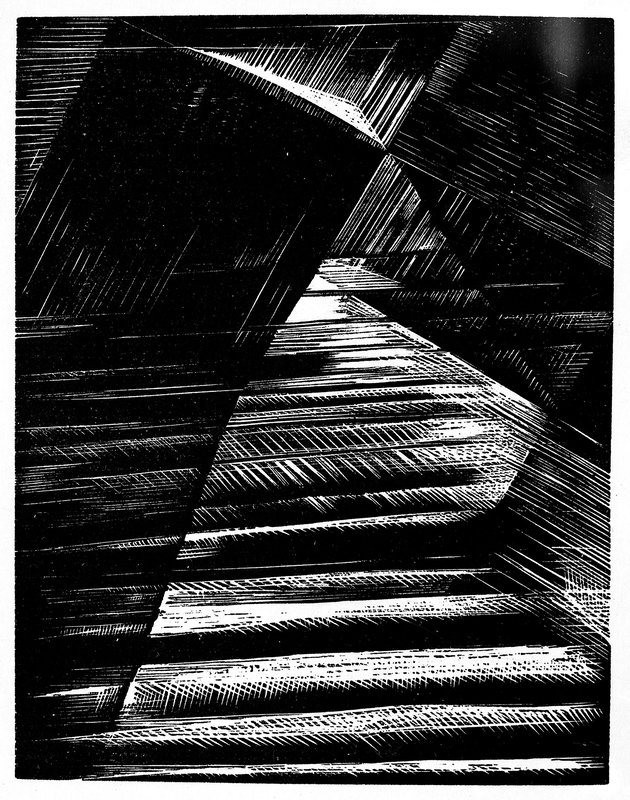
Artist: Paul Nash
Date: 1924
From: Genesis
 The Widening Gyre